Does the Noahic Covenant Prohibit the Death Penalty for All But Murder?

Here’s a little more analysis of the discussion on theonomy from the other day.

I initially asked about their claim that the death penalty for bestiality was unjust, and in his first comment, C Jay said, “And the Bible, properly interpreted, does not give permission to anyone to execute capital punishment except in the case of murder per the Noahic Covenant.”

Here’s Genesis 9:5-6, the relevant portion of the Noahic covenant to which he is referring, “And for your lifeblood I will require a reckoning: from every beast I will require it and from man. From his fellow man I will require a reckoning for the life of man. Whoever sheds the blood of man, by man shall his blood be shed, for God made man in his own image.”

But is this passage teaching that the death penalty is only to be used for murder? It specifies the death penalty for murder, but specifies no penalty for anything else. If you’re going to take this to say that only murderers should receive the death penalty, then you have to say that the government shouldn’t punish any other crime, including rape and kidnapping.

That is certainly not what Genesis 9 is teaching, but C Jay never responds to the objection that that is where his logic leads. Here is why C Jay’s is wrong that the death penalty is prohibited by the Noahic Covenant (except for murder):

1. The doctrine of bloodguiltiness.
2. The Mosaic civil law wasn’t given to only the Israelites.
3. The Noahic covenant isn’t called law.

Bloodguiltiness

In Genesis 4, Cain murders Abel, and Abel’s innocent blood has a voice that calls out to the Lord (Genesis 4:10). God is aware of every drop of innocent blood that is shed, and He will account for it, as He says in Genesis 9. This is called the doctrine of bloodguiltiness.

And later in history, the Lord reveals that murder isn’t the only crime that causes bloodguiltiness. In Leviticus 20:10-16, several different sexual sins are listed, including bestiality and homosexuality. For each of the sexual sins listed it says, “their blood is upon them.” These sexual sins don’t involve the shedding of blood, yet there is bloodguilt in the sin, so the death penalty is pronounced for each one. Is bloodguilt something that comes and goes with covenants? Certainly not.

The Law Wasn’t Given to Only The Israelites

Saying that the law was only given to the Israelites is a point that also fizzles under more scrutiny. Leviticus 20:23 says, “And you shall not walk in the customs of the nation that I am driving out before you, for they did all these things, and therefore I detested them.” The Canaanites that lived in Israel’s land before them suffered the death penalty at the hand of the Israelites for all the sins listed in that chapter, including the sexual sins. The Lord expected them to be sexually pure. There are other examples of other nations adopting or being held accountable to Israel’s law.

The Noahic Prohibition of Murder Isn’t Called Law

Romans 5:13-14 says that there was no law until Moses. That would preclude the Noahic covenant as offering a law. The rest of Scripture never calls the laws of any other country law. It often refers to their lawlessness–even nations that prided themselves on their laws, like the Romans. Check out this excellent article on that topic.

Conclusion

It is wishful thinking to believe that the Noahic covenant prohibits the death penalty for all but murder. Genesis 9 is only nine chapters into the Bible. The Lord, starting in the next book of the Torah, reveals a perfect and just civil law. If you reject it, there is no standard of justice to call any civil law just or unjust. C Jay (and none of the others I’ve ever asked these questions of) ever answered my questions about justice, because there are no answers. C Jay refused to discuss those questions, claiming that his covenant theology dictates that theonomy is wrong.

Well, if there’s one thing I know, it’s that theonomy is true, and C Jay never provided one valid argument against it. So if your other theology dictates that theonomy is wrong, either your other theology is wrong, or you’ve misapplied it.

Cut Off Funding

This is a great interview! Chipping away at local issues  is something the average person can be doing. Everyone is worried about the presidential candidates while it’s the local school district, building department and police that are killing liberty. What if we were able to eliminate a proposed tax increase to support those organizations– Or maybe even cut their budget?

I’ve always thought of local politics as boring, but I can really have no effect on a presidential election, whereas I can have an effect on local issues.

Here’s the interview:

https://www.youtube.com/watch?v=h-uDzLu2LEw

And here’s Paul Dorr’s website:  www.rollbacklocalgov.com

Refuse Service to Thugs

A Whataburger employee near Dallas refused service to two cops. I wouldn’t recommend doing that. You’ll probably end up being sued in today’s evil age. However, I certainly believe that any business that doesn’t want to do business with someone ought to be able to refuse service to anyone they want, for any reason they want.

PS

And, I can see why someone wouldn’t want to do business with cops. They are the agents of a government and a country under God’s wrath, who enforce evil, pagan, unjust laws.

Where to operate a restaurant, you have to:

  • Do business with people you don’t want to do business with.
  • Prohibit people from smoking on your own property.
  • Get all kinds of permits to start a business.
  • Get permits to remodel your building.
  • Pay exorbitant property taxes.
  • Pay exorbitant income taxes.
  • Jump though tons of hoops when hiring employees.
  • Collect sales tax on every sale and send it in.

Whatever you’re angry about the government doing, you can thank a cop for forcing people to do it.

For example, try remodeling or operating a restaurant without government permits. Initially a bureaucrat will show up. This guy doesn’t carry a gun, and doesn’t force anyone to do anything. But if you don’t cooperate with him, rest assured the cops will be close behind, and they will force you to do what the bureaucrat says.

So I’m completely understanding of the Whataburger guy not wanting to serve cops. I hope more businesses stop serving cops.

Ignorance of the Law Is No Excuse

I can see why this cop wouldn’t know about the right to free speech, and is scared of having people lined up leafleting. After all, the right to free speech is covered in the 8973rd Amendment, paragraph (j), section (iii).

Oh wait. That’s not right. It’s the First Amendment. He’s just on a massive, ignorance-fueled power trip.

But you know what really galls me is the people thanked the cop at the end. I realize it’s probably just habit, and it makes me mad, because I’ve done the same thing. I’ve thanked cops for handing me a ticket. It makes me sick thinking about it. They should thank me.

Of course, every single on of that cop’s paychecks is him committing fraud. He’s supposed to know the law. Soliciting is selling something. Passing out literature isn’t soliciting.

Here’s the best comment on this video:

“Sorry, Officer, you can’t use the terms “break it up” or “get a permit” without a special permit from the “break it up / get a permit” licensing board, which is located in Room 1984 of the Doubleplusgood Building on Oceania Boulevard. Yeah yeah, being a policeman gives you certain authority, blah blah blah, never mind, just be a good boy and run along to the licensing office. Quit asking why.”

I can see why that dirtbag would be against passing out Constitutions.

Another Theonomy Debate

It seems this simple question can not be answered by non-theonomists: When Muslims cut off a thief’s hand, is that unjust?

The Bible provides the proper punishment for stealing, homosexuality, murder, kidnapping, adultery, etc. I would guess that most Christians like the biblical punishment for stealing. The problem is if they accept that, they have no basis for rejecting the punishment for adultery and homosexuality, which they don’t like.

These guys put up a lot of barriers to discussing theonomy, but we had a fairly long discussion, until it just became apparent they have no answer for my objection, and now they won’t even post my last comment. I’m sure they’re nice guys, and we’d probably agree on a large percentage of laws, it’s just that they arrive at them for a different reason.

They claim to have a biblical basis for rejecting theonomy, but it seems more like smoke and mirrors to me.

Here’s my argument:

  1. Theonomic laws are just.
  2. Just laws ought to be the laws of the land. (He agreed to this one.)

The problem is that there is no basis for rejecting the first point if you reject theonomy. Non-theonomist Christians may be able to eliminate a lot of unjust laws, but ultimately, there’s no way of knowing what sins ought to be civilly punished, or how, without the only place in the Bible that explains it.

Their defense against theonomy is that Baptists have a different covenant. I think I cut through that when he agreed that just laws ought to be the law of the land. The only argument left is how to determine whether a law is just or not, which as you’ll see they never responded to my many questions about that.

If they have an answer for my simple question, why don’t they give it? What is their absolute standard of justice? The guy wrote 6 comments and never got around to gracing me with his explanation.

Here’s the discussion:

Avatar

I left a comment here the other day. It still hasn’t shown. I’ll try to repost it to the best of my recollection.

You said, “Thomas Granger’s hanging was unjust.” This presupposes an absolute standard of justice. What is your absolute standard of justice?

  • Avatar

    Sorry Bill. I had approved it but do not see it either. Don’t know what happened.

    The Bible is the absolute standard of justice. And the Bible, properly interpreted, does not give permission to anyone to execute capital punishment except in the case of murder per the Noahic Covenant. The exception to this was during the Israelite theocracy, but since the civil law was abrogated with the covenant, we cannot use it as the basis for our present situation. Thus, we must lean on the Noahic Covenant since the world is still under that one.

    Avatar

    Where does the Noahic covenant specify the penalty for theft, rape, kidnapping, etc.?

    • Avatar

      It doesn’t. You’re obviously trying to make a bigger point, namely, that unless the Bible tells us exactly what civil law code we ought to have today, we can’t have any justification of criminal prosecution. But in any case, I can’t categorically adhere to your theonomic conclusions because, as per the above essay, I reject your formulation of Covenant Theology on which theonomy depends.

      • Avatar

        You’re making it too complex. The civil law is obligatory because it is perfect and just. If we’re free to choose whatever laws we want (even if you wanted to constrain it by the moral law), why can’t we choose Old Testament civil laws? If you reject theonomy, you no longer have an absolute standard for justice. You don’t know what justice is for any crime except murder.

        Avatar

        Correctly exegeting Scripture is “making it too complex” for theonomists.

        Avatar

        I’m not making anything complex. I believe that the Mosaic Civil law was provided under the Covenant that was given to national Israel. This Covenant has been abrogated. Therefore, the Civil Law given to national Israel has been abrogated. Simple.

        No everything that is perfect and just is obligatory. For instance, God’s command to Abraham that he kill his son was perfectly just. But it is not obligatory for people who are not Abraham. Were God’s dietary laws just or unjust? If just, are they obligatory (of course, we’d both answer no)? If unjust, how can a just God give an unjust command? Similarly, just because God’s civil law was just does not mean it is obligatory for people to whom it has not been given.

        (I should also point out that the Covenant under which the Civil Law was given was in fact *imperfect* and thus needed to be replaced by a Covenant that was perfect. But that is a reference to the Covenant, not the Civil Law itself, so I won’t press that secondary point home.).

        “why can’t we choose Old Testament civil laws?” You can. No one is stopping you or the other theonomists from voluntarily agreeing to a covenant in which such laws are enforced. We only reject the idea that they are obligated to be forced on all of society who dissents (such as us Baptists). But yes, we libertarians certainly would let you build such a community just like we’d let a group of idealist socialists build a covenant community based on the community ownership of property as long as every member voluntarily agrees to be there (please don’t interpret me to be saying socialists and theonomists are similar!)

        “If you reject theonomy, you no longer have an absolute standard for justice.” Translation: if you do not interpret the Civil Law as I do, you must obviously not be using the Bible to build a case for justice. In which case, I don’t really have a response except, okay.

        Avatar

        You said, “No one is stopping you or the other theonomists from voluntarily agreeing to a covenant in which such laws are enforced.”

        I would contend that is what the early colonists did. Those who executed Thomas Granger were carrying out theonomy. Yet you have called his execution unjust. Do you believe Christians are free to enforce unjust laws?

        1. If I have to choose between a just law, and an unjust law, which should I (as a Baptist) choose?

        2. You said, “Translation: if you do not interpret the Civil Law as I do, you must obviously not be using the Bible to build a case for justice. In which case, I don’t really have a response except, okay.”

        You keep saying you have an absolute standard for justice. I’ve yet to hear any specifics except that you think those who shed blood ought to be executed. What is the just penalty for rape? When Muslims cut off a thief’s hand, is that just? Do you differentiate between accidental homicide and murder, and on what basis?

        Avatar

        “I would contend that is what the early colonists did.” No, Granger did not voluntarily agree to these rules. If he did, I will change my opinion about the justness of the situation.

        “Do you believe Christians are free to enforce unjust laws?” No.

        1. You should choose a just law.
        2. You are missing the entire point, which is what I previously stated. I am denying your presumption “that unless the Bible tells us exactly what civil law code we ought to have today, we can’t have any justification of criminal prosecution.” If you want specifics, we can look into that, but first you have to understand my approach. Especially, you have to understand that someone’s inability to come up with a just system does in no way make a positive proof of theonomy. Since the present context is about theonomy I would encourage you to stick with that. My view that the abrogation of the Mosaic Covenant renders the Civil Law abrogated and thus, there is no specific law code that God demands of nations today. Like Calvin said, each nation is free to initiate laws that are appropriate for its specific context (I agree with the general approach of this, though I have my own modifications and clarities to add) precisely because there is no modern national Israel. National Israel pointed to the church in a type/antitype way. Your disapproval of this does not prove theonomy. Which is what the present post should be about. The specifics of laws is a different conversation.

        • Avatar

          “Granger did not voluntarily agree to these rules.”

          I don’t see how someone agreeing to certain laws makes an unjust law enforceable. At best, it would mean that he committed suicide, and the people who helped/forced him to commit suicide are guilty of murder.

          You said, “Like Calvin said, each nation is free to initiate laws that are appropriate for its specific context (I agree with the general approach of this, though I have my own modifications and clarities to add) precisely because there is no modern national Israel.”

          I’ve kept asking for your absolute standard of justice, and this appears to be it. Justice is whatever is “appropriate for its specific context.” Maybe you can see why I’m not impressed with the absoluteness of your absolute standard of justice.

          You have no basis for saying that the death penalty for bestiality is unjust. The Noahic covenant is silent on that. You have no basis for saying Muslims cutting off a thief’s hand is unjust, or that the death penalty for adultery, rape or homosexuality is unjust.

          You have no basis for saying whether theonomy is good or bad– just that it doesn’t line up with your personal opinion. You need to repent of you false personal opinions.

          • Avatar

            Im having a hard time Bill because you are not following my arguments at all. The reason I pointed out that Granger did not voluntarily agree to these rules is because you asked me what was wrong with building a community in which theonomy was *chosen* to be the rule of the land. I said if such rules were voluntarily agreed to, i’d have no problem (because my only argument is that theonomy is not obligatory). You said that the Puritan societies were indeed voluntarily. I disagreed by expressing my understanding that Granger did not voluntarily agree.

            As for Calvin, again you are not following my point. My point there is not that kings can do whatever they want. My point is clearly that, like Calvin, I believe that Israel Civil laws are not obligatory and binding on nations today. They may borrow from these laws, adopt them, or learn from their principles, but God does not treat the modern nation like he did national Israel. That is the extent to my citing Calvin. I don’t even agree with Calvin’s views of an ideal civil order, preferring instead the much more “libertarian” approach of the later English dissenters and especially the New England Reformed Baptists

            I haven’t even mentioned or argued yet my “absoluteness of your absolute standard of justice.” I keep trying to help you realize that I am merely, in the present context, explaining why I cannot adhere to the theonomic system. So you can come back at me all day about how I haven’t impressed you with my case yet, and my response will always be: “I know. That’s because I haven’t explained it yet. The context of our conversation is why I am not a theonomist.” I am making a negative case *against *theonomy,* not a positive case *for* libertarianism.

            “You have no basis for saying whether theonomy is good or bad– just that it doesn’t line up with your personal opinion.” Actually, and contrarily (perhaps you didn’t read the above essay and the links posted at the end), I have explained time and again that my basis for rejecting theonomy is exegetical. Your blaming it on “my opinion” indicates to me that you have no willingness to engage in a meaningful dialogue.

            “You need to repent of you false personal opinions.” I will repent when I am convinced A) that my understanding of Covenant Theology and the nature of the Kingdom of Heaven is wrong; and B) that someone else’s understanding of these things is correct. Until then, I see no need to repent, because I believe that I have understood the Bible correctly (that’s why I believe it.). You and I have our differences of understanding of the nature of certain exegetical conclusions, but it is unhelpful to demand my repentance until I first see where I err. And to be clear, since there are a variety of differing views on Covenant Theology in the Reformed tradition, your command that I repent could just as well be applied to anyone else in the Reformed world with whom you disagree.

            Avatar

            Yes. I’m having a difficult time following you. It seems you have contradicted yourself repeatedly. Clearly I’m missing something.

            If I moved into a HOA where the covenants said the death penalty was required for someone who painted their house the wrong color, would it be acceptable as a Christian for me to submit to the death penalty, or for one of my neighbors to carry out the death penalty? If it’s not acceptable, why would it be acceptable for someone to submit to the death penalty for bestiality in a theonomic society?

            As far as all the links and the pages of documents you’ve written, it seems like obfuscation. I’ve tried to converse with you about several specific, concrete examples, and I can’t get you to commit to anything.

            Avatar

            Time to move on. Bill, you have not addressed a single argument in this post. You, like most theonomists, insist that theonomy must be true a priori, regardless of what Scripture says. You presuppose theonomy, not Scripture.

            Not having a standard of justice for modern nations today does not thereby make theonomy true. That’s a logical fallacy that Van Tillians are fond of.

            Of course I do believe Scripture provides us with a standard of justice (lex talionis, of which Gen 9:6 is an example), but the present issue is whether the civil laws of Israel continue to bind all nations, not whether Scripture provides us with a standard of justice.

            Avatar

            “I’ve tried to converse with you about several specific, concrete examples, and I can’t get you to commit to anything.” —Do you understand that there are two different issues here (1: whether theonomy is biblically justified and 2: what “my standard of justice is”)? You seem to be pressing me to answer 2, but I am trying to explain why I disagree with you on 1.

            Hence the talking past each other. I cannot be a theonomist, regardless of my own political theory. My understanding of covenants and kingdoms don’t let me. If you want to ask me about why I am a libertarian, I suggest you do so via email or in another comment section where the context calls for it.

            As for Granger, did or did not Granger agree that he should be executed before he committed his action? You said it was a voluntary set of laws. Can you prove this?

Implications for Non-Theonomists

lntheonomy

I see three possible positions you can take regarding theonomy.

1. Theonomy is false. God doesn’t care about justice. Governments
can do whatever they want.
2. Theonomy is false. God doesn’t care about justice. Governments
can do what they want as long as they follow the moral law.
3. Theonomy is true. God cares about justice.

If theonomy is false, then it’s not just that God doesn’t care
about justice. It’s that there’s no longer a standard for justice.
We can no longer say whether a law is just or not.

To say the Old Testament civil law is unjust presupposes an absolute standard of justice. To claim the civil law is unjust is a self-refuting, self-contradictory sentence. There is no other standard for justice.

True Christianity and Immigration

bm

Bojidar Marinov says:

In the 1890s, the Roman Catholic bishop of New York complained that the Roman church is losing a large number of its members among the coming immigrants. And that almost immediately after they leave Ellis Island.

The reason?


The Presbyterian churches of New York had an round-the-clock watch to wait for the groups of immigrants who came out of the immigration facility on Ellis Island, and offered them temporary shelter and English courses, as well as low-pay temporary employment in the city. (While politics was controlled by the Irish mafia of Tammany Hall, the business in the city was controlled by Presbyterians and Dutch Reformed. It wasn’t until John D. Rockefeller – a fundamentalist Baptist – moved his Standard Oil headquarters to NYC that a major non-Presbyterian player appeared on the market.) This changed the play field entirely.

Keep in mind that 65% of the Arabs in the US are Christians. At least half of them have converted AFTER they arrived. Of those who don’t convert, the vast majority either become secularized, or have already been secularized in their home countries.  There is no reason why the [current crop of refugees from Syria] won’t have an even higher percentage of conversions.

Great Discussion on Homeschooling: Is Accepting Stolen Money a Sin?

I’ve written on this blog that I think that accepting tax money that was stolen is a sin. I was surprised to see what Bojidar Marinov had to say on that:

“I am not so hard-core as many people: I don’t believe USING tax money is sin per se, and I don’t believe we should excommunicate people for being on government payroll. It’s not because I am lax on the Law of God but because an ethical/judicial view of the Law requires that I focus on where the REAL CRIME is: The process of TAKING the money, not the process of their distribution. Thus, you won’t hear me criticizing government schools for the fact that they use tax money: the money is already stolen, and the secondary use of stolen money is not declared a crime in the Bible. In fact, short of returning that money to the tax-payers – which we don’t have the power to accomplish, yet – distributing it to areas where Christians will make use of it is a sort of “common-grace” remedy which mitigates against the worst aspects of the crime of taxation. Declaring the use of that money sin would guarantee that the money is forever lost for any good cause.”

———————————————–

I can see his argument, but I think the following comment from Paul Dorr closes the deal for me.

———————————————–

“…the process of distributing it” is not a real crime? Not sure I understand your position on this Bojidar Marinov. Consider Prov. 29:24 which says, “Whoever is a partner with a thief hates his own life; He swears to tell the truth,[a] but reveals nothing.” Government school administrators and teachers lie every day (in my work) about how they spend the stolen money. They clearly mark themselves as partners with the state/thief.


Psalm 50:18 says, “When you saw a thief, you consented with him…” School administrators and staff consent to spend the stolen money every day.

Even man’s law has a crime on the books called “receiving stolen property”. Not quite as serious as the original thievery, but a crime none-the-less.

Some of the greatest opposition my clients receive daily, is from fellow evangelical Christians with their children in the public school. I believe there is no greater temple to our statist idolatry than government stools….err, schools! We need to remove our children and rip our money out of their hands. God will bring them to an end….and I believe sooner than we think.

———————————————–

Bojidar goes on to say:

I agree with you, Paul, about government school administrators and teachers who lie about the use of the money. And of course, your argument about “consenting with thieves” is perfectly correct.

Here’s an application of the problem, though, where I am
afraid, I can’t see a solution within the more purely perfectionist position you take on it: A communist state where all property is government property, and all business is government business, and thus all jobs are on the government’s payroll. The land is stolen from its original owners, the capital was confiscated from private owners, the industrial facilities are stolen, the technology for production is stolen, the children in the schools and the kindergartens are stolen from their parents, the capital infrastructure was built on the compulsory labor of political prisoners, etc., etc.

A Christian with a family finds himself in such a situation. He has certain gifts and skills, and he knows he has to bide his time instead of going full-scale revolutionary resistance against the government. He has to feed his kids as well. But any gainful employment he can take is on government payroll, receiving stolen money for work, using stolen capital goods, on infrastructure built on the labor of political prisoners.

He has the choice, of course, to refuse to work and thus starve his family. But I somehow can’t see this as the Biblical solution. After all, Joseph could have refused to serve Pharaoh and could have stayed in jail. Therefore, the only judicial solution I see to the issue is that he is free to take a job – which will by necessity be a government job – and that being on government payroll is not sin per se. (Although, I agree with you that school administrators who lie WITH THE PURPOSE OF STEALING more of their constituents’ money ARE in sin.) Therefore, the sin is not in being on government payroll, it is in being on the robbing side of government – which is the case of your school administrators, but not necessarily of everyone who in one way or another receives a pay from the school.

I relate this issue to the much misunderstood issue of Ron Paul’s support for ear-marking funds. It was used by his enemies to create an image of a politician who is in favor of more taxes whereas his position was perfectly logical: “If I can’t stop the increase of the government budget, I need to at least make sure the money is not just given as general spoils to the bureaucrats but its purpose is specifically declared.”

I am willing to hear where I am wrong in this.

———————————————–

Here’s what I say. Bojidar is correct in his example of a communist country. Americans are in the same boat as a citizen of a communist country in some areas. I have no choice but to drive on roads that were built with stolen money. There is no alternative other then flying a helicopter, which is not a viable alternative due to financial constraints. But, where we have a choice, we ought not accept stolen money. And, where we have a choice, but choose to accept stolen money it is a sin.

Tyrants Twisting the Law

The popular thing for the politically correct class to do today is to not make any claims to certainty. Of course, this is an absurd position, because typing a sentence is a claim to certainty of whatever you’re talking about. For example, it is self-refuting to say, “There is no such thing as absolute truth.”

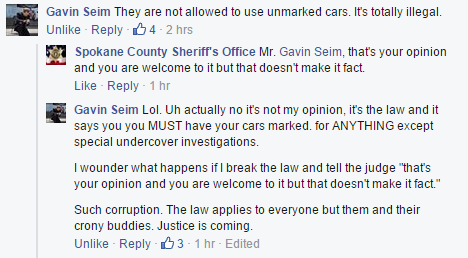
Gavin Seim got the Spokane Sheriff to engage in such absurdity on its Facebook page, and pointed out their error pretty effectively:

spokaneconvo

Maybe they’re saying the law is what they want it to be. Maybe they’re saying there’s no way of knowing what the law is. Maybe they’re saying Gavin is completely wrong, and they’re just not willing to say, “You’re completely wrong.” I don’t know.

What they ought to do is have the county attorney write up a press release, explaining why it’s legal for them to use unmarked cars for traffic enforcement (assuming they actually believe they have a case for such), and then link to it when this topic comes up. This issue has become big news with some of Gavin’s videos on this topic getting hundreds of thousands of views.

But it shows where they’re coming from that they can get snarky with a citizen on their public Facebook page. What business can get snarky without losing business? A government monopoly: that’s who. They’ve shown they’re not there to serve people or correct misunderstandings of the law, but to do whatever they want. And they don’t even care who knows it.

PS: I was wrong about how many views Seim’s videos have had on the unmarked car issue. The video below (and he has at least one other I can think of) has over 4 million views, and was also played on CNN.